


The average COBOL developer in the United States earns $115,475 a year (ZipRecruiter, March 2026). That figure sits comfortably above the median for all software developers. For a language routinely declared dead, this is a strange way to decompose.
COBOL turned 67 this year. Technology conferences rarely mention it. Computer science departments almost never teach it. Yet the salary data tells a story that contradicts the obituaries. Employers are paying more for COBOL talent today than they were five years ago, and the gap between supply and demand keeps widening.
The disconnect between narrative and reality is the single most important thing to understand about this market. Pundits frame COBOL as a relic. Hiring managers frame it as a staffing crisis. Both perspectives contain truth, but only one of them shows up in compensation data. What follows is a close look at the numbers, the industries, and the dynamics that explain why COBOL developers still command serious money.
The Salary Numbers, Unfiltered
Start with the headline figures. ZipRecruiter pegs the national average at $115,475, with a 25th-to-75th percentile band of $100,000 to $136,000. Related titles push even higher: COBOL Engineer averages $118,624, and Mainframe Application Developer sits at $101,800. These are not outlier postings. They represent the central mass of the market.
Now compare that against Salary.com's Texas-specific data from February 2026, which reports an average of just $79,524. The 90th percentile in Texas barely cracks $93,476. That is a $36,000 gulf between the two sources for nominally the same job.
The gap is not a mistake. It reflects a structural split in the COBOL labor market. ZipRecruiter's dataset skews toward job postings in high-cost metro areas and includes a heavy proportion of contract and consulting roles, which carry rate premiums. Salary.com draws more heavily from employer-reported base salaries for permanent staff, often in lower-cost regions. When you see the ZipRecruiter number, you are largely looking at what it costs to hire someone right now, urgently, on a contract basis. The Salary.com number reflects what long-tenured FTEs actually take home.
Both numbers are real. Neither is the whole picture. A hiring manager in Dallas will not pay $136,000 for a permanent COBOL programmer. A bank in Manhattan scrambling to fill a mainframe vacancy before an audit deadline will pay that and more. Understanding which number applies depends entirely on the role type, location, and urgency of the hire.
How Salaries Have Moved Over Five Years
According to Zippia's trend data, the average COBOL programmer salary rose from $75,997 in 2021 to $84,879 in 2025. That is an 11.7% increase over four years, or roughly 2.8% annualized.
For context, general software engineer salaries grew at roughly 4-5% annually over the same period, outpacing COBOL on a percentage basis. But the comparison is misleading. The software engineering market added hundreds of thousands of new entrants during that stretch. The COBOL market did the opposite. Retirements removed experienced practitioners faster than any pipeline replaced them.
The job posting volume tells a sharper story. Zippia's data shows 2,991 COBOL job postings in 2017, falling to 2,783 in 2018 and then collapsing to just 660 in 2019 (Zippia). The COVID-era years brought a partial rebound: 992 postings in 2020 and 1,038 in 2021. That recovery had less to do with growth and more to do with state unemployment systems breaking under load and agencies realizing they had no one on staff who could fix them.
The pre-2019 drop deserves attention. The steep decline from nearly 3,000 postings to 660 likely reflects a combination of consolidation in mainframe operations and a shift toward contracting agencies that absorb demand without posting individual roles publicly. The jobs did not vanish. They moved behind the curtain of staffing firms and preferred vendor lists.
The salary increase, modest in percentage terms, is better understood as a lagging indicator. COBOL compensation has been sticky because so many practitioners are mid-career or late-career employees on established pay bands. The real price signal shows up in contract rates, which have moved significantly faster.
Where the Jobs Actually Are
Financial services dominates COBOL hiring. BizTech Magazine reported in late 2025 that 71% of mainframe teams are understaffed, with financial services as the single most active hiring sector. Banks run transaction processing, account management, and regulatory reporting on COBOL-based mainframes. Replacing those systems is a multi-year, multi-hundred-million-dollar proposition that most institutions have deferred repeatedly.
Insurance follows closely. Policy administration systems, claims processing, and actuarial batch jobs rely on COBOL codebases that have accumulated decades of business logic. The cost of rewriting that logic, and the risk of getting it wrong, keeps the maintenance workforce employed.
The federal government is the largest single employer bloc. An ACT-IAC report from December 2024 documented that OPM alone holds 1,780 COBOL programs. The IRS, Social Security Administration, and Department of Veterans Affairs all maintain substantial COBOL estates. Zippia's data confirms the geographic footprint: Washington, D.C., has a 94% employment concentration index for COBOL roles, and Virginia sits at 35%, reflecting the density of federal contractors in the Beltway corridor (Zippia).
State governments remain significant employers as well, particularly for unemployment insurance and Medicaid eligibility systems. The pandemic exposed how fragile these systems were, and many states are still working through backlogs of maintenance and modernization. Retail rounds out the picture, with large retailers operating inventory and supply-chain systems built on mainframe COBOL.
Integrative Systems estimated in March 2026 that 43% of enterprises still rely on COBOL-based systems. That figure has remained stubbornly stable for years, declining only incrementally as modernization projects chip away at the edges.
The Contractor Premium
Contract and consulting COBOL rates routinely run 30-40% above equivalent full-time salaries. A permanent COBOL developer earning $115,000 as an FTE might command $150 to $180 per hour as an independent contractor, translating to $300,000 or more in annualized billings.
The premium exists because of a pure supply constraint. The pool of available COBOL contractors is small, aging, and not growing. When an organization needs someone immediately, for a mainframe migration, a compliance deadline, or a production outage, there is no surplus labor to absorb the request. The contractor who is available sets the price.
This dynamic is self-reinforcing. As FTE salaries remain anchored to corporate pay bands, experienced COBOL developers have a financial incentive to leave permanent positions and move to contract work. Every departure tightens the FTE market, which drives up contract demand, which pulls more people out of permanent roles. The retirement rate driving that supply squeeze accelerates the cycle further.
The Bureau of Labor Statistics projects roughly 5,500 computer programmer openings per year across all languages, with essentially all of that demand coming from retirements and transfers rather than net new positions. For COBOL specifically, where the median practitioner age skews well above the broader programming population, the replacement math is particularly unfavorable. Each retirement removes not just a person but decades of institutional knowledge about specific codebases, and that knowledge cannot be replicated through a job posting.
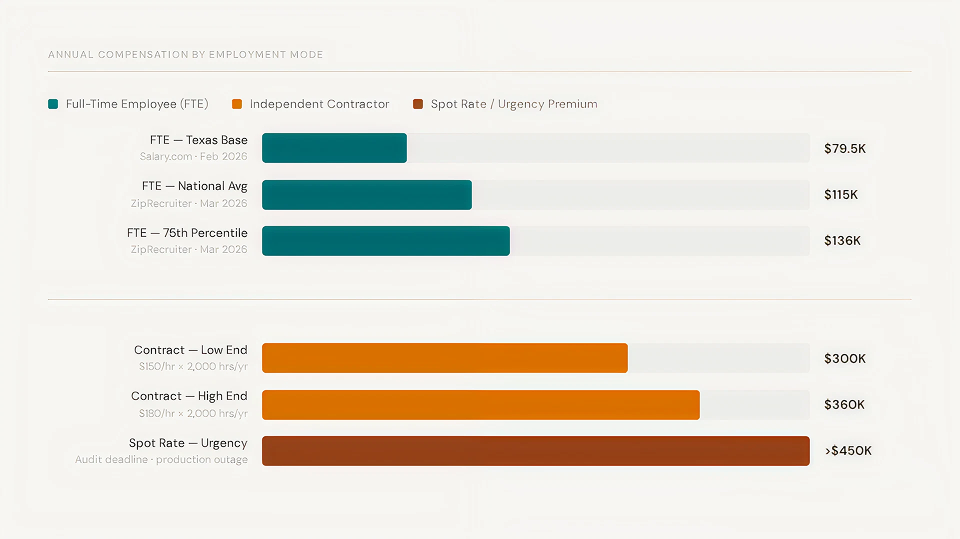
COBOL retirements drive up pay, especially for urgent contract work.
Who's Still Posting, and What They're Really Asking For
COBOL job descriptions in 2026 look different from those posted a decade ago. The language itself is still the anchor, but employers now treat it as one node in a required skill cluster. The most common combinations are COBOL plus JCL (Job Control Language, needed to run batch processes on mainframes), COBOL plus DB2 (IBM's mainframe relational database), and COBOL plus CICS (the transaction processing middleware that handles real-time workloads).
A posting that asks for just COBOL in isolation is rare. Employers want practitioners who can operate across the full mainframe stack, from writing the application code to managing the job schedules to tuning the database queries. This reflects the reality of how these systems work: COBOL code does not run in a vacuum. It runs inside an ecosystem of tightly coupled components, and understanding what happens when a migration goes wrong requires familiarity with all of them.
Job descriptions have also started including hybrid requirements. It is increasingly common to see postings that pair COBOL with Java, Python, or cloud platform experience. These roles sit at the intersection of maintenance and modernization. The employer wants someone who can keep the existing system running while simultaneously participating in the effort to replace it. That combination of skills is exceptionally rare, and it commands the highest compensation within the COBOL market.
The shift toward hybrid postings also reveals something about employer expectations. Many organizations have accepted that pure COBOL maintenance is a holding pattern, not an end state. They want developers who can serve as bridges between old and new architectures. Finding someone who speaks both fluently is the hardest hire in mainframe IT today.
What This Market Looks Like in Three Years
The supply side will get worse before it gets better. The median age of COBOL practitioners continues to climb, and the training pipeline is negligible. A widely discussed thread on Reddit's r/programming captured the practitioner consensus: "The real shortage is 5-10 years out." The logic is straightforward. Enough senior COBOL developers are still working today to fill most current vacancies, even if it takes longer and costs more. But the retirement curve is steep. Within three to five years, the number of retirements will exceed the market's ability to backfill.
Salaries will respond, but not symmetrically. Contract rates will continue climbing faster than FTE compensation, because organizations facing acute shortages will pay whatever the market requires to keep critical systems operational. FTE salaries will rise more gradually, constrained by corporate pay bands and internal equity considerations. The gap between the two will widen.
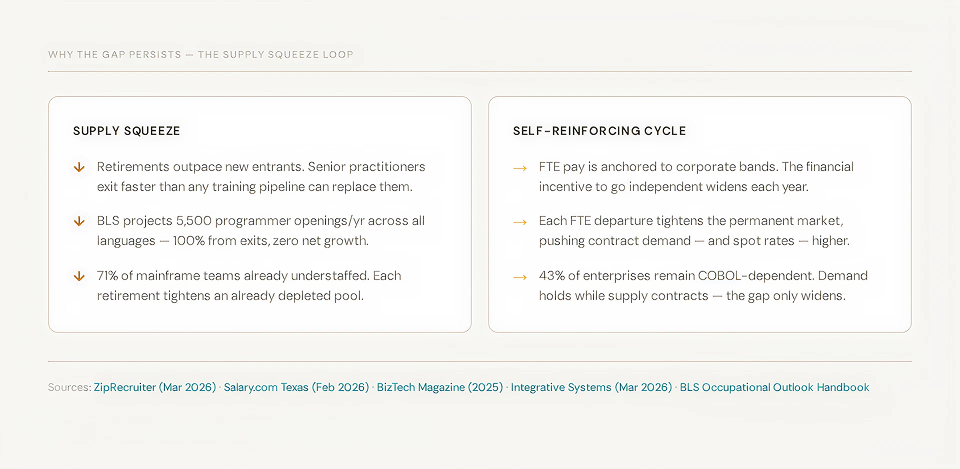
Contract pay rises faster than FTE salaries as shortages persist.
The demand side is harder to predict. Integrative Systems' estimate that 43% of enterprises still rely on COBOL-based systems suggests a large installed base, but modernization projects will gradually reduce it. The question is pace. If migration timelines continue to slip, as they historically have, the demand for COBOL talent will remain elevated well into the 2030s. If AI-assisted code conversion tools mature enough to accelerate migrations, demand could soften faster than current projections suggest.
Neither outcome eliminates the need for COBOL expertise in the medium term. Even aggressive modernizers need COBOL developers to maintain systems during the transition. And for the 71% of mainframe teams already understaffed (BizTech), the staffing gap is not a future problem. It is a current one.
For workforce planners, the arithmetic is clear. The COBOL labor market is not collapsing; it is contracting on the supply side while demand holds steady. That mismatch will push compensation higher, make contractor relationships more expensive, and force increasingly difficult build-versus-buy decisions. Organizations that have deferred succession planning will pay the steepest price. Those that invested in cross-training or maintained relationships with experienced contractors will have options. Everyone else will be bidding against each other for a shrinking pool of specialists who have the leverage to choose their assignments.