


Somewhere in a mid-Atlantic city, a 62-year-old programmer is cleaning out his desk. For 34 years, he maintained the batch-processing system that reconciles overnight transactions for one of America’s ten largest banks. His retirement party is on Friday. His replacement has not been hired. The job posting has been open for eleven months.
This is not a hypothetical. Variations of this scene play out every quarter at banks, insurance carriers, and government agencies across the United States. The people who understand the COBOL systems that move trillions of dollars each day are leaving the workforce faster than new talent arrives. The question is no longer whether a gap exists. The question is how wide it gets before something breaks.
How Big Is the Workforce, Really?
Pinning down the exact number of active COBOL developers is harder than it should be. The Bureau of Labor Statistics groups them under “Computer Programmers,” a category that covers every language from Python to assembly. That broad classification masks what is happening inside the COBOL niche. Industry estimates from the late 2010s placed the global COBOL workforce between 800,000 and two million, but those figures mix full-time specialists with programmers who touch COBOL occasionally as part of a broader role.
What the BLS data does confirm is direction. Employment for computer programmers overall is projected to decline 6% between 2024 and 2034, with roughly 5,500 openings per year generated almost entirely by retirements and occupational transfers. Growth is negative. The profession is shrinking in absolute terms, and COBOL represents the oldest, most retirement-prone segment within it.
Phil Teplitzky, a mainframe workforce researcher, reported in 2019 that the average COBOL developer was 58 years old, with approximately 10% of the workforce retiring each year. That rate has only accelerated as the cohort ages. If even a conservative version of that estimate holds, the community of specialists who can maintain the 240 billion lines of active COBOL that still run critical infrastructure is losing thousands of experienced practitioners every year, according to ACT-IAC’s Legacy Code Modernization report. Many of these developers are the sole experts on the specific subsystems they manage. When they leave, the knowledge leaves with them.
The Retirement Math
The arithmetic is simple and unforgiving. Start with Teplitzky’s baseline: an average developer age of 58 and a 10% annual retirement rate. Apply that to even a modest estimate of 100,000 dedicated COBOL specialists in the United States. That yields 10,000 exits per year. Meanwhile, the BLS projects only about 5,500 total annual openings across all programming languages, generated predominantly by people leaving the occupation. The replacement pipeline falls short before COBOL even begins to compete with Python, Java, and cloud-native stacks for incoming talent.
A Compounding Problem
Attrition compounds in ways that raw headcount does not capture. Each departing developer takes decades of institutional knowledge with them: undocumented business rules embedded in code, workarounds for ancient hardware quirks, batch-job dependencies that nobody else understands. The cost of losing a senior COBOL developer is not just the salary of the new hire. It includes months or years of ramp-up time during which the replacement will be less productive and more error-prone.
A BizTech Magazine survey in late 2025 found that 71% of mainframe teams are already understaffed and 54% are underfunded. These are not projections about some future workforce cliff. They describe the present. The retirement wave is not approaching; it arrived during the pandemic and has been accelerating since. The organizations hit hardest are often the ones least equipped to respond: government agencies with rigid civil-service pay scales and regional banks operating on thin IT budgets.
What the Training Pipeline Actually Looks Like
University computer science programs stopped teaching COBOL years ago. The ACT-IAC report published in December 2024 confirmed what practitioners had long observed: COBOL is no longer part of standard CS curricula at American universities. Students graduate fluent in Java, Python, C++, and JavaScript. They do not learn a language that first appeared in 1959, regardless of how much commerce still depends on it. Professors who once taught mainframe programming have themselves retired, and no one replaced them either.
Industry-Led Efforts
The gap has prompted private-sector intervention. The Open Mainframe Project, a Linux Foundation initiative backed by IBM and Broadcom, offers a free COBOL Programming Course and runs an LFX mentorship program designed to onboard junior developers into mainframe ecosystems. IBM has separately invested in its Z Xplore learning platform and academic partnerships with a handful of universities. These programs are real. They produce graduates who can write and read COBOL.
But scale is the problem. The mentorship cohorts number in the low hundreds per cycle. The industry needs tens of thousands of new practitioners over the next decade. Even optimistic estimates of combined training program output suggest that current initiatives replace, at best, a single-digit percentage of annual retirements. The throughput is an order of magnitude below what would be needed to stabilize the headcount, let alone grow it.
There is also a motivation gap. A 22-year-old developer choosing between a career path in cloud-native microservices and one in mainframe COBOL will almost always pick the option with more visible career progression, a larger peer community, and trendier employer brands. COBOL work is stable and pays well, but it lacks the cultural cachet that drives early-career decisions. No bootcamp advertises a COBOL track. No influencer on YouTube builds a following around JCL tutorials.
The Gap, Quantified
The ACT-IAC report estimated 84,000 unfilled mainframe positions as of 2020. That figure predates the post-pandemic retirement surge and the labor market disruptions that followed. It also coincides with a code base that has not shrunk. The same report documents 240 billion lines of COBOL still in active operation, running everything from Social Security benefit calculations to interbank settlement systems to state unemployment processing.
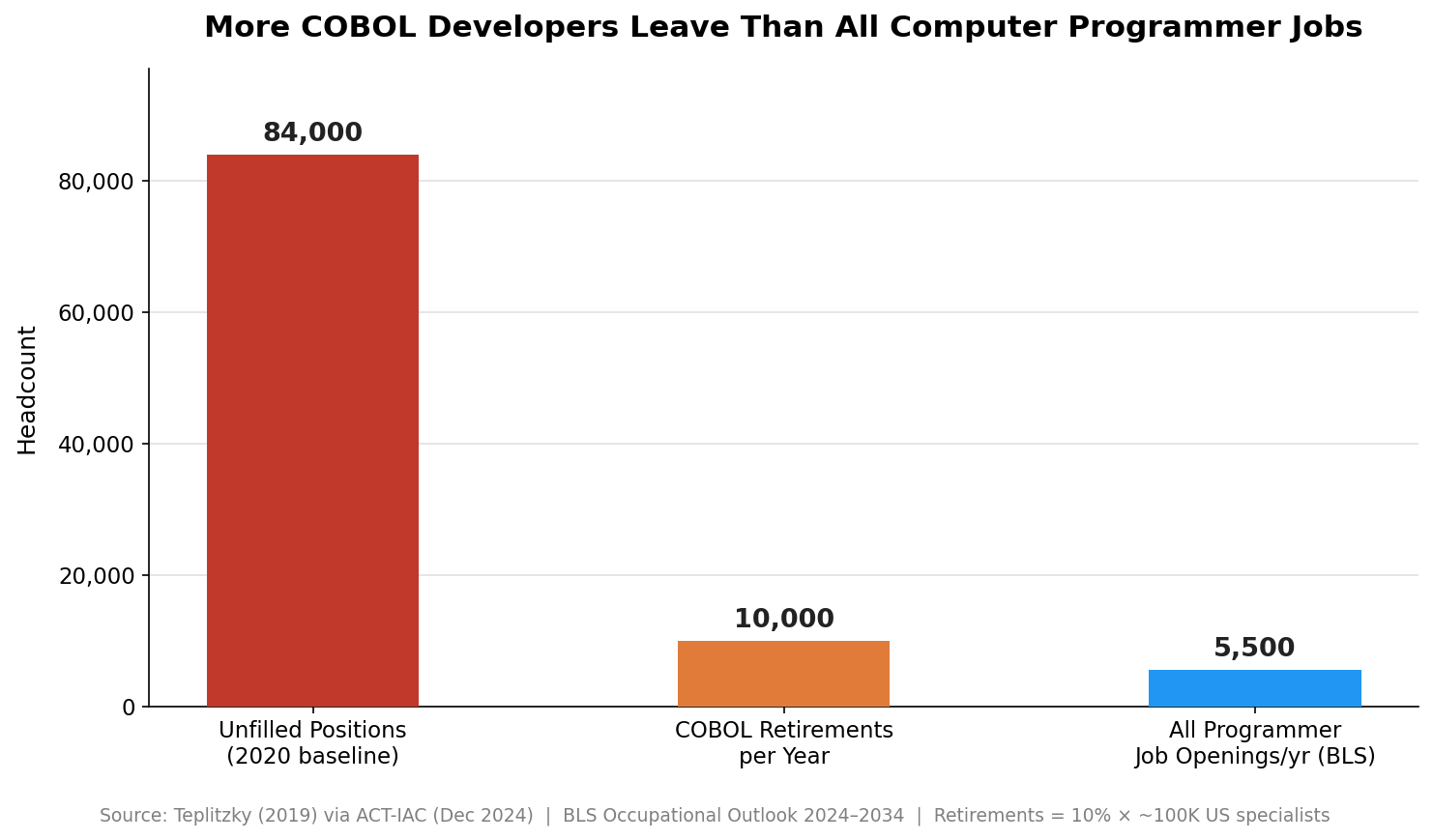
COBOL job gaps far exceed all other programmer openings.
Structural Mismatch
This is a structural mismatch, not a temporary hiring blip. The demand side is anchored by code that cannot be quickly replaced. Large-scale COBOL modernization projects routinely take five to ten years and cost hundreds of millions of dollars. Many fail outright or stall mid-execution when requirements change or funding lapses. Until that code is actually migrated, every organization running it needs people who can read it, modify it, and troubleshoot it at 2 a.m. when a batch job fails.
The OPM case study from the ACT-IAC report illustrates the complexity. The Office of Personnel Management runs 1,780 COBOL programs. An internal audit found that roughly 20% were unused and 80% were classified as low complexity. That sounds manageable on the surface. But “low complexity” still means thousands of lines of decades-old code that must be understood in the context of surrounding systems and business logic. And the 20% classified as unused? Someone still has to confirm they are truly inactive before decommissioning them. That verification itself requires deep COBOL expertise.
The GAO reinforced this picture in a February 2022 report, finding that at least ten federal agencies faced persistent difficulty recruiting COBOL-skilled staff and were paying premium contractor rates to fill even routine maintenance roles. Federal systems that process payroll, tax returns, and benefits for hundreds of millions of Americans depend on a talent pool that Washington cannot reliably access.
Who’s Still Hiring, and at What Price
Compensation data tells its own story about supply and demand. As of March 2026, ZipRecruiter reports the average annual salary for a COBOL developer at $115,475, with top earners exceeding $152,000. Those numbers are competitive by any standard, and they reflect the scarcity premium now built into the market. For a broader view of COBOL job postings and salary trends by industry, regional variation adds another dimension to the picture.
FTE vs. Contractor Economics
Salary.com pegs the average COBOL programmer salary in Texas at $79,524 as of February 2026. Compare that to the national average north of $115,000 and the gap reveals a two-tier market. Government agencies and employers in lower-cost states hire full-time staff at the lower end of the range. Financial institutions and federal contractors on the coasts pay contract rates that can reach $100 to $150 per hour, effectively doubling the fully loaded cost of the same skill set.
Year-over-year salary data from Zippia shows COBOL programmer compensation climbing from $75,997 in 2021 to $84,879 in 2025, an 11.7% increase over four years. That trajectory outpaces general wage growth across the technology sector, another signal of tightening supply against persistent demand. Zippia’s data also reveals that COBOL-specific job postings peaked in 2017 and 2018 and have declined since. The decline does not mean demand vanished. It means some organizations shifted from direct hiring to outsourcing arrangements, while others simply deferred maintenance work they could no longer staff.
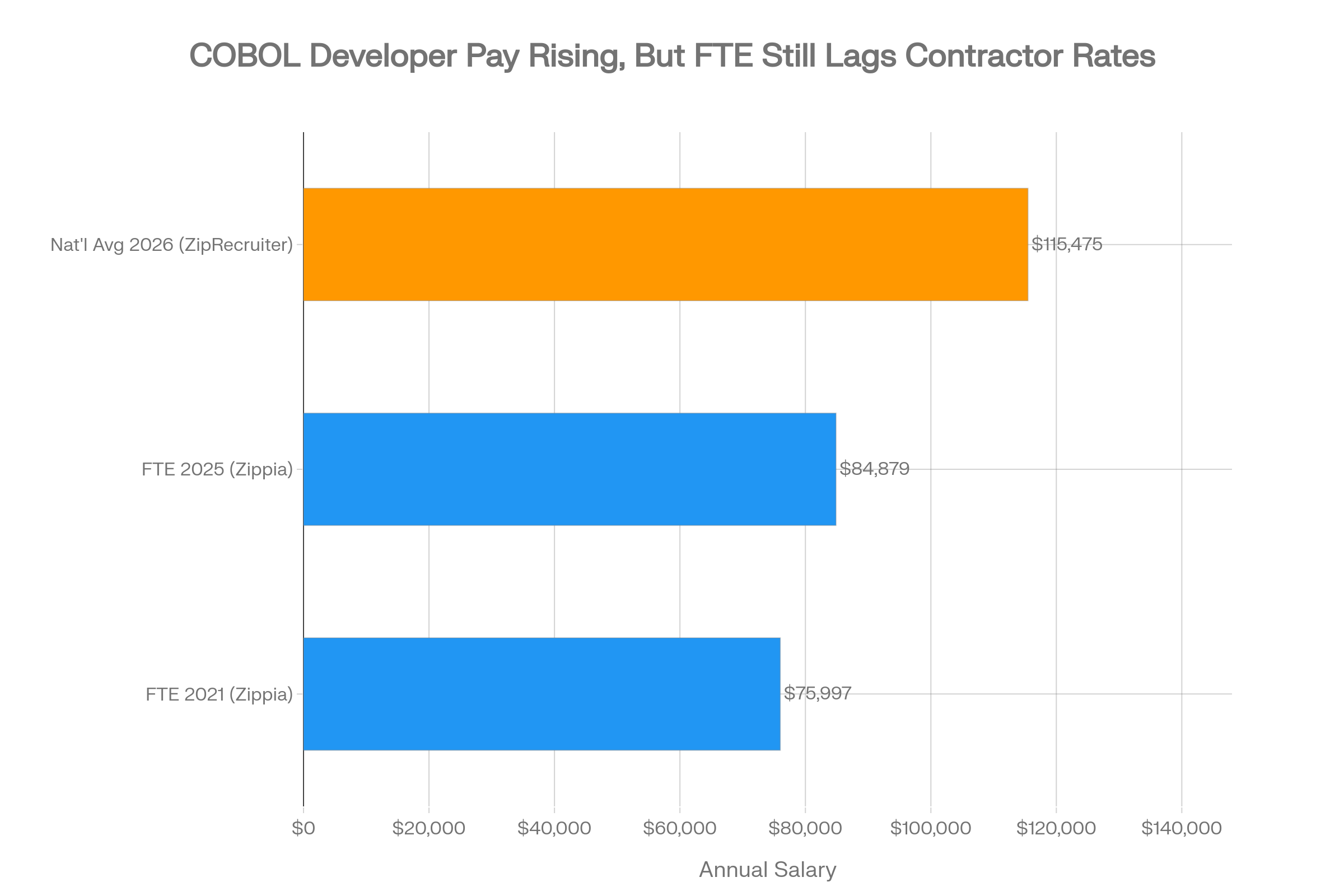
COBOL developer pay rises faster than tech sector average.
The contractor premium is particularly visible in government IT procurement. Agencies that cannot compete on salary or speed of hiring turn to staffing firms, which mark up individual rates by 40% to 60%. The GAO’s 2022 findings confirmed what agency procurement officers already knew: the government pays more per developer-hour for less continuity, because it enters the market late and moves slowly through its own hiring processes. The result is a cycle where the public sector’s inability to retain full-time COBOL staff pushes costs higher, which further strains the budgets that were already insufficient.
None of this resolves cleanly. The retirement curve is demographic, not cyclical. Training programs operate at boutique scale against an industrial-sized deficit. Modernization timelines stretch across budget cycles and leadership changes, often outlasting the executives who commissioned them. What remains is an operational reality that CTOs and agency heads must plan around rather than plan away: the people who keep these systems running are leaving, the people who could replace them mostly do not exist yet, and the systems themselves are not going anywhere soon. The organizations that treat this as a staffing problem will manage it, imperfectly but deliberately. The ones that treat it as someone else’s problem will discover, one failed batch job at a time, that it was always theirs.
Related insights
Introducing Hopper: An Agentic Development Environment for the Mainframe
Hopper is an agentic development environment for the mainframe that lets AI agents operate directly across TN3270, ISPF, JCL, JES, CICS, VSAM, datasets, jobs, spool output, and return codes.
Replicate the Environment, Not the Knowledge
Mainframe modernization breaks when tacit knowledge gets flattened into documentation and abstractions. A better approach is to create faithful environments where that logic can be explored directly.
COBOL Job Postings Over Time: Salary Trends and Which Industries Are Still Hiring
COBOL is still a high-value labor market: demand remains strong in banking, insurance, and government, while a shrinking, aging talent pool keeps salaries and especially contract rates elevated.
Championing for Legacy Modernization Internally
Legacy failures are board-level business risks, not IT issues: when critical transaction systems break, the fallout is measured in fines, outages, customer loss, and stalled growth.